A floor coating can look great on day one and still fail fast if the prep is wrong. That’s why shot blasting vs grinding is not a small detail, it’s the job.
If your slab needs a smoother finish, tighter edge work, or prep for decorative work, grinding often wins. If you need fast, aggressive texture on a large open slab, shot blasting usually pulls ahead. The right call depends on slab condition, coating type, and how the floor needs to perform.
Start with the surface profile your system needs
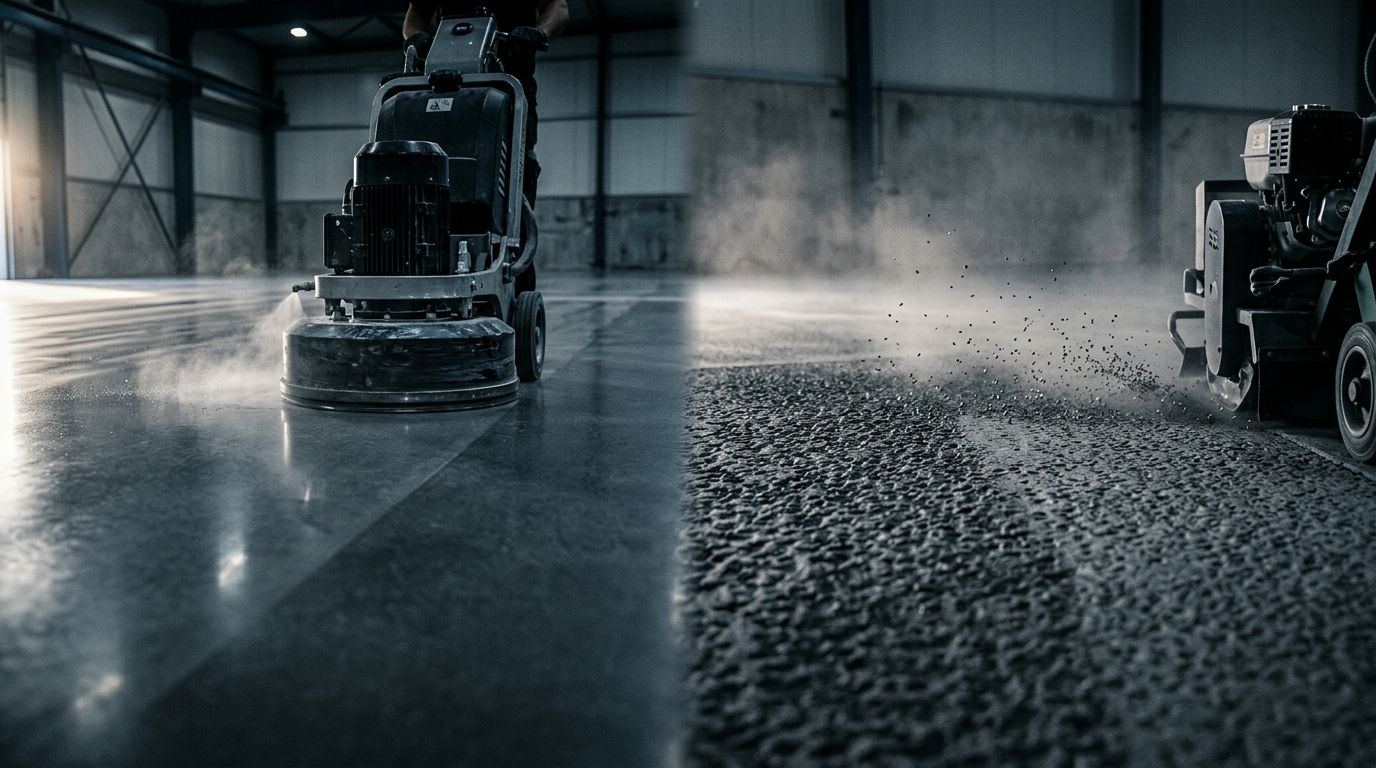
Both methods mechanically prep concrete, but they leave different surfaces behind. Grinding cuts the slab with diamond tools. Shot blasting throws steel shot at the floor, then recovers it with a vacuum system. One smooths and opens the surface. The other cleans and textures it more aggressively.
That difference matters because coatings bond to surface profile, not to guesswork. A thin concrete epoxy coating or clear epoxy coating for concrete often wants a cleaner, more even surface. Heavier resin systems, repair mortars, and some overlays may need a rougher anchor pattern. In most cases, grinding lands in a lighter profile range, while shot blasting creates a deeper profile faster.
Here’s the quick side-by-side view:
| Factor | Grinding | Shot blasting |
|---|---|---|
| Typical profile | Smoother, lighter | Rougher, more textured |
| Best for | Finish-sensitive work, edges, patch blending | Large open areas, strong profile, heavy contamination |
| Removal ability | Thin coatings, high spots, light residue | Brittle coatings, laitance, surface contamination |
| Edge work | Strong | Weak, usually needs follow-up grinding |
| Final look | More refined | More industrial |
| Speed on open slabs | Moderate | Fast |
Previously coated slabs change the decision. Grinding can gum up on soft adhesives or thick elastomeric films. Shot blasting usually handles weak paint and surface crust better, but it may still leave detail work behind. Indoors, grinding is common in tighter rooms because crews can control the machine better. Outdoors, both methods can work on dry slabs, but wind, moisture, and access often shape the plan.
The main takeaway is simple. Good concrete dealing starts with the slab and the coating spec, not the contractor’s favorite machine.
Pick the prep method that matches the required profile and the slab’s real condition. Speed only matters after that.
When concrete floor grinding is the better fit
Grinding gives you more control. That makes it a strong choice for garages, basements, small rooms, and remodel work where the slab has edges, doorways, drains, and patchy repairs.
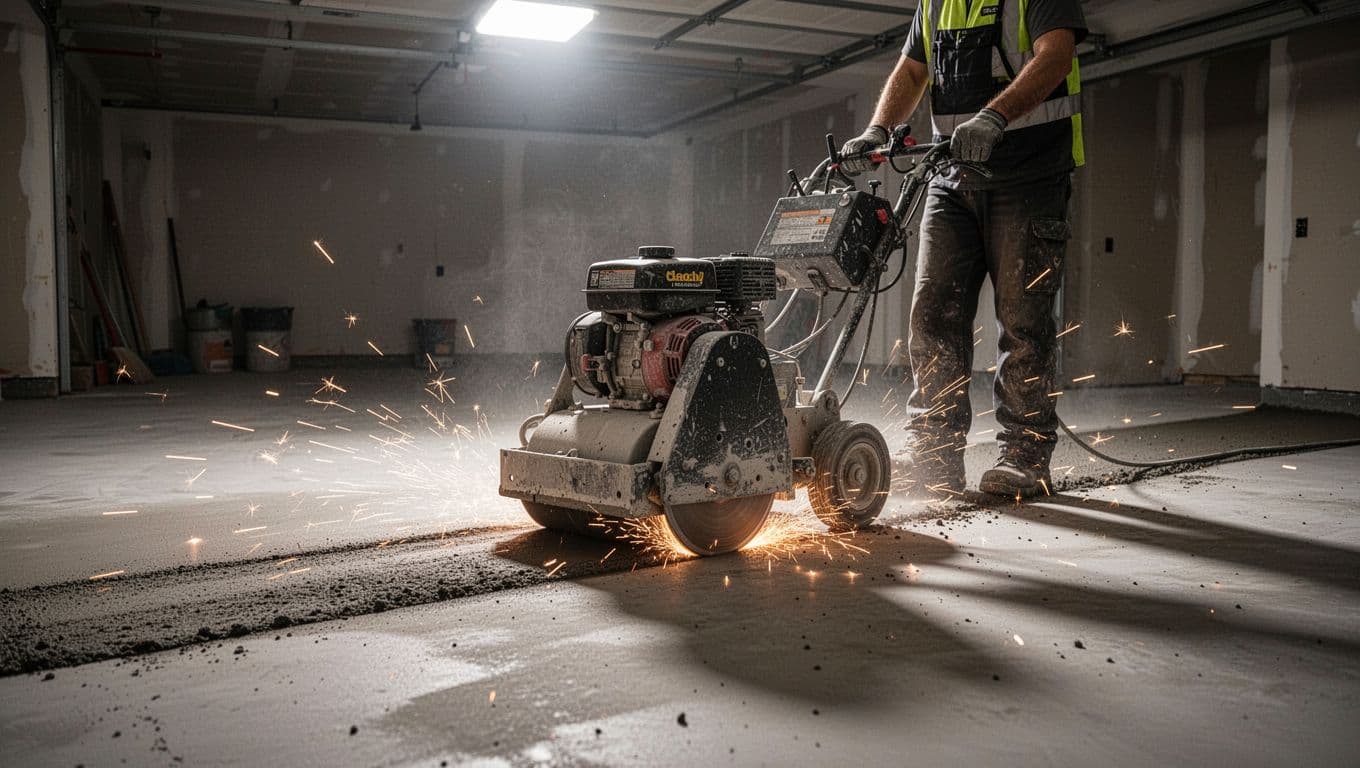
If you want an epoxy coating for garage floor, grinding is often the cleaner fit. It can remove light sealers, thin paint, tire-mark residue, and small high spots while keeping the floor more even. It also reaches close to walls, and hand grinders can finish corners that a larger machine misses. That matters for a basement concrete coating, where tight spaces and wall lines show every shortcut.
Grinding also works better when the finished look matters. It’s the natural path for concrete polishing and often part of the prep before concrete staining. If the goal is a smoother decorative floor, shot blasting usually leaves too much texture. The same logic applies when a homeowner wants a refined flake system or a neat epoxy coating for concrete in a garage or workshop.
For uneven slabs, grinding can feather patch edges and shave minor lips. Still, it won’t flatten a badly heaved slab by itself. It also has limits with deep oil soak, thick mastics, and rubbery residue. Indoors, good vacuums keep dust under control, but edge grinding can still throw fine dust. Noise is steady, though usually less harsh than a blaster.
- Grinding fits finish-driven floors, edge-heavy rooms, and moderate surface correction.
- It struggles when coatings are thick, contamination is severe, or the job needs a deep profile fast.
Any garage floor epoxy coating company worth hiring should explain why it chose grinding, not simply say it always does.
When shot blasting is the better fit
Shot blasting shines on large, open slabs where speed and bite matter most. Think warehouses, service bays, retail back rooms, or a big commercial garage with old traffic film and weak surface paste.
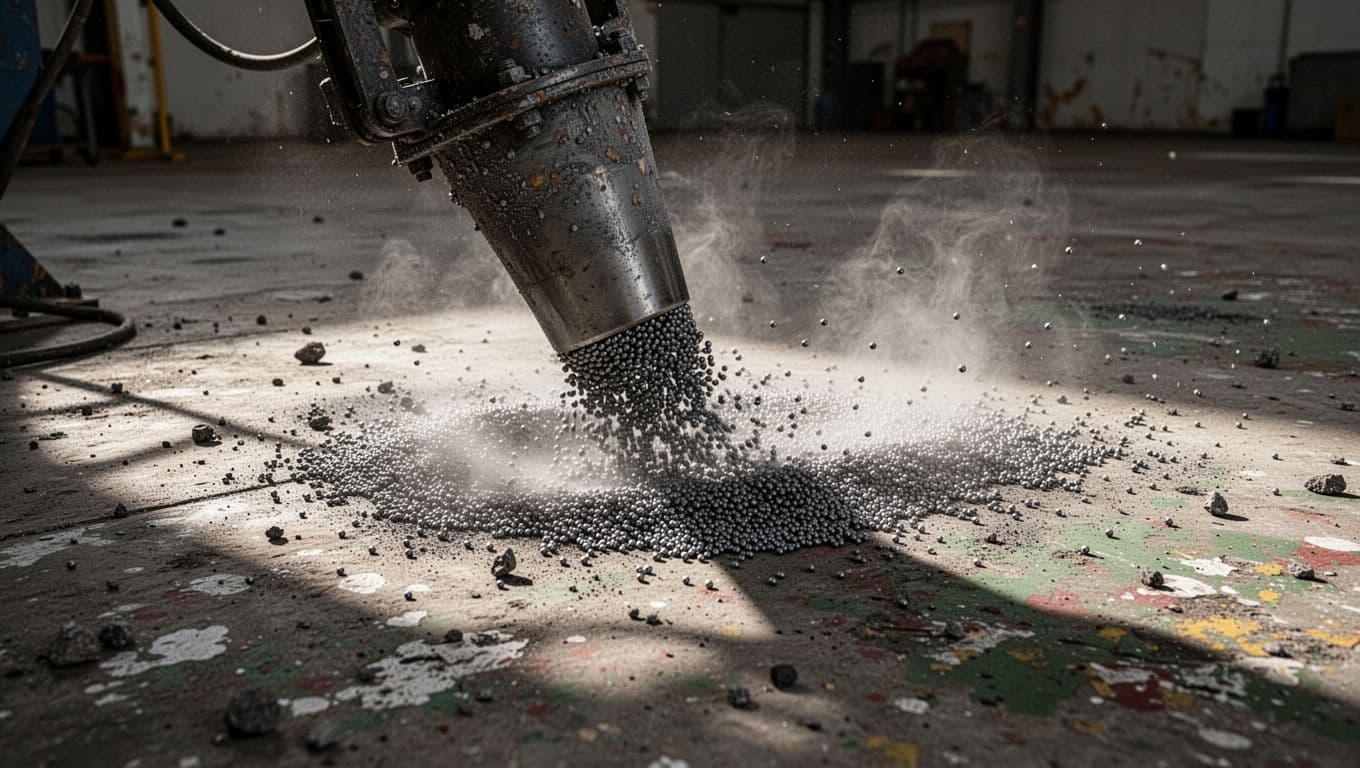
Because it creates a more aggressive profile, shot blasting is often the better base for commercial concrete epoxy coating, thicker resin systems, and some overlay installs. It can strip brittle coatings, remove laitance, and clean surface contamination faster than grinding on wide-open floors. Many crews like the production rate, since a self-contained blaster can move fast and keep dust collection tight at the same time.
This method is a strong fit for previously coated slabs when the old film is weak, flaky, or poorly bonded. It also makes sense when the final system needs a firm mechanical grip, such as a heavy-build epoxy base with a polyaspartic coating on top. In those cases, a rougher profile can help the system lock in.
There are tradeoffs, though. Blasters don’t do edges well. Most projects still need grinding around walls, columns, and door tracks. The surface also stays rougher, so it’s not the right choice when you want a near-polished look. Noise is sharper, and the machine needs open space to work well. Indoors, that’s often fine on commercial floors. In small residential rooms, it can be awkward.
Shot blasting also won’t solve moisture. Before a basement or ground-level coating job, moisture testing for epoxy coatings still matters, because bond failure often starts below the surface.
- Shot blasting fits large open slabs, fast production, and coatings that need a stronger anchor.
- It falls short at edges, in tight rooms, and on floors where the final finish must look smooth.
The practical choice for your project
Most homeowners land on grinding because garages and basements are edge-heavy, finish-sensitive spaces. Many commercial projects lean toward shot blasting because open square footage rewards speed and a stronger profile.
If the slab is uneven, lightly coated, or headed toward concrete polishing, grinding usually makes more sense. If the slab is broad, contaminated, or getting a heavy-build system, shot blasting often makes the safer base. On many jobs, the best answer is both, shot blast the field, then grind the perimeter and detail areas.
Ask one thing before you approve any bid: what profile does the coating need, and how will the crew get it? That answer tells you more than any color chart.