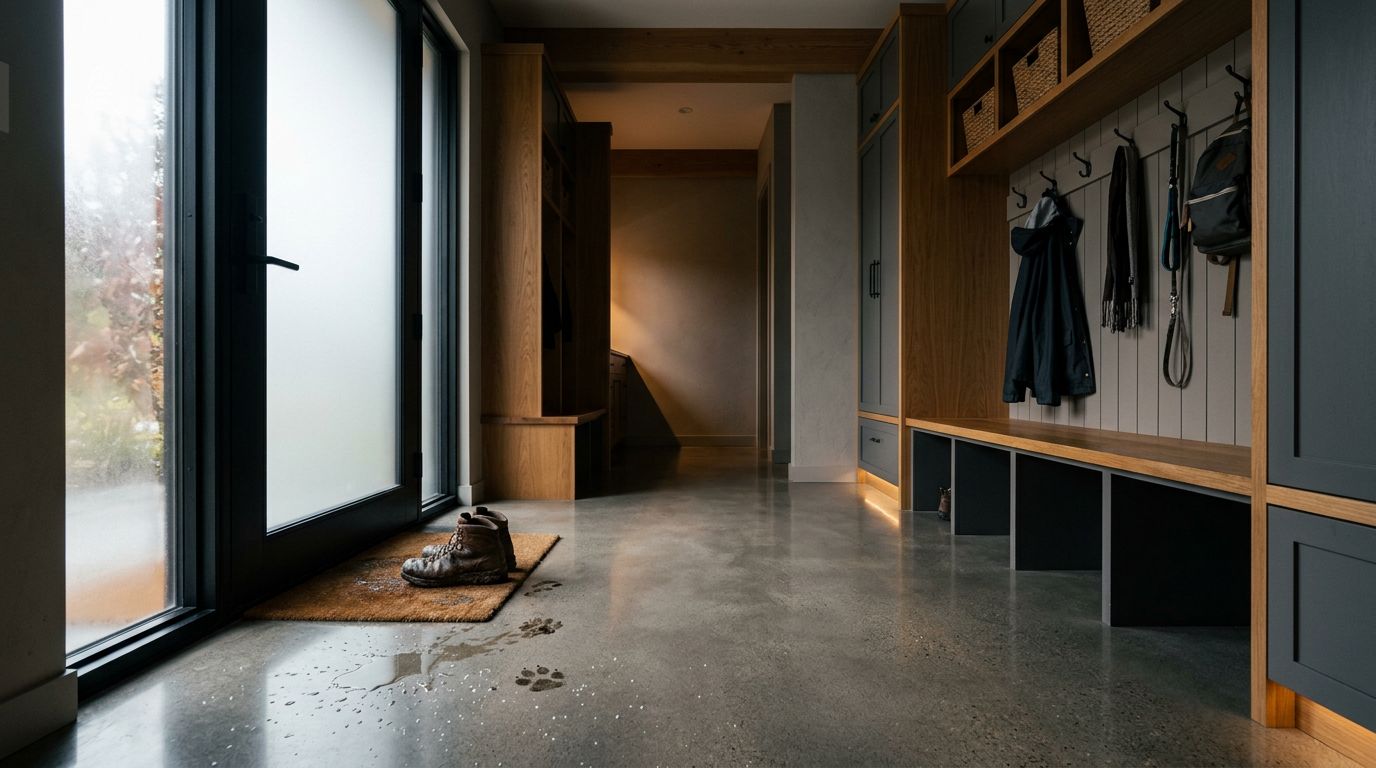
Mudrooms collect the mess your house would rather avoid. Wet boots, muddy paws, road salt, and grit can make a nice floor look dirty by noon.
That’s why concrete floor finishes for mudrooms need more than good looks. The right finish has to shed water, resist stains, keep its grip, and still look tidy after a long day of traffic.
Start with how the room gets used, because the cleanest floor on paper isn’t always the cleanest floor in real life.
Why mudrooms are so hard on floors
Mudrooms take a steady beating. Water sits by the door. Salt dries into a chalky film. Sand grinds under shoes. Pet nails add scuffs, and cleaning happens often.
Bare concrete can handle the abuse, but it doesn’t always stay easy to live with. It can darken when wet, hold onto fine dirt, and show wear near the threshold. A finish changes that. It seals the surface, slows staining, and makes cleanup faster.
Many homeowners first notice this benefit in a garage. The same idea behind an epoxy coating for garage floor projects works just as well in a busy entry area. You’re still trying to stop water, dirt, and salt from soaking in or hanging around.
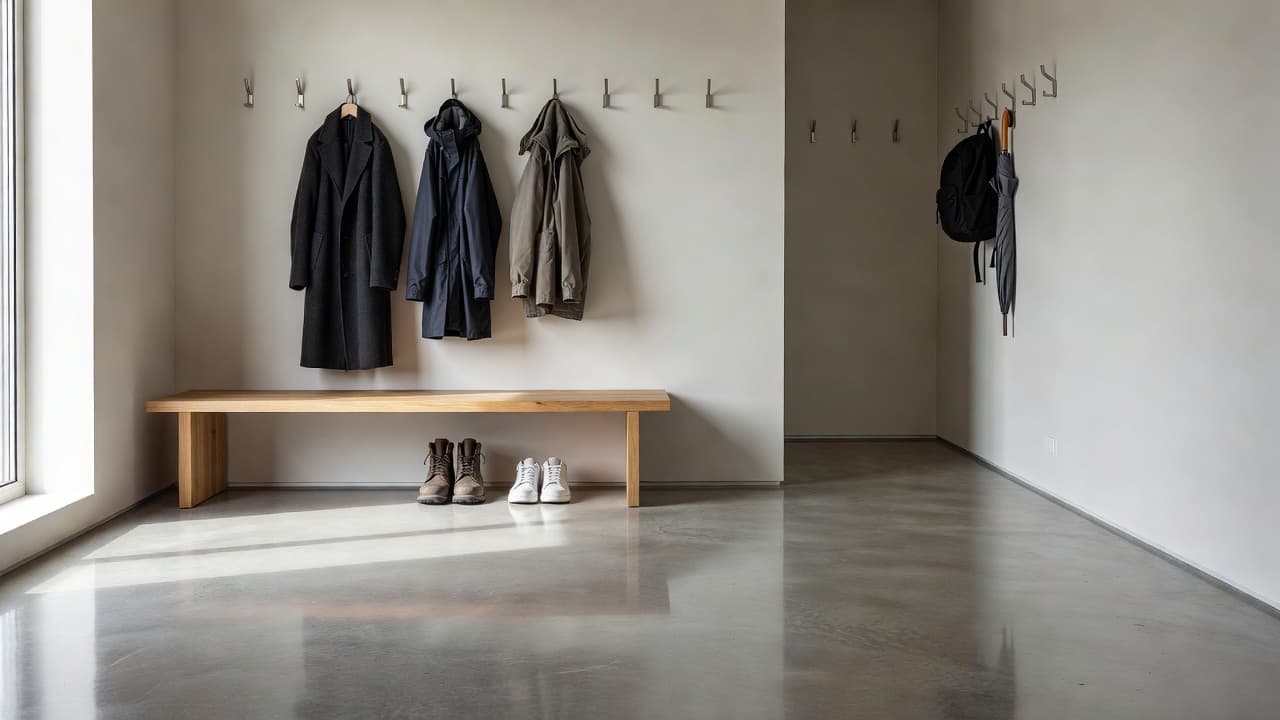
Concrete also gives you flexibility. You can polish it for a clean modern look, stain it for more warmth, or coat it for stronger stain resistance. Among all mudroom floor choices, concrete is one of the few that can be tuned to your household instead of forcing your household to adapt to the floor.
That last part matters. A retired couple in a dry climate can live happily with a smoother, glossier finish. A family of five with two dogs and soccer cleats usually needs more texture, less shine, and better salt resistance.
Comparing the concrete finishes that stay clean
Before picking a color or sheen, it helps to compare how the main options behave day to day.
| Finish | Handles well | What it shows | Traction | Upkeep |
|---|---|---|---|---|
| Polished concrete | Dry dirt, dust, light traffic | Wet prints, salt haze, scratches in high gloss | Fair to good, depends on sheen and sealer | Low, but needs frequent dry cleaning near doors |
| Stained and sealed concrete | Mud, light spills, moderate traffic | Wear in sealer paths, dirt in textured sealers | Good with satin sealer | Moderate, reseal as needed |
| Epoxy with traction additive | Water, salt, pet mess, heavy cleaning | Dust on dark solid colors, chips if prep is poor | Good to excellent | Low |
| Epoxy with flake and polyaspartic topcoat | Mud, grit, stains, hard family use | Less dirt overall because pattern hides debris | Good to excellent | Low |
For most homes, the best-looking floor after six months isn’t the glossiest one on day one. It’s the one that hides daily mess and releases it fast when you mop.
Polished concrete looks crisp, but it shows more
Concrete polishing gives a mudroom a clean, bright feel. The surface is dense, hard, and simple to sweep. If you like modern interiors, polished concrete can look sharp without added coatings that may peel.
However, polish has limits in a wet entry. High-sheen polished floors show footprints, paw marks, and salt residue quickly. They can also feel slick when water sits on top, especially near an exterior door.
A satin or lower-sheen polish works better than a mirror finish here. So does a smart color choice. Mid-tone gray usually hides dust better than charcoal or bright white. If your household deals with snow, rain, or dogs, polished concrete fits best when the mudroom is more of a transition zone than a splash zone.
Stained and sealed concrete feels warmer
Concrete staining adds color without burying the slab under a thick layer. It works well if you want an earthy, natural look that doesn’t feel industrial.
The catch is the sealer. In a mudroom, the sealer does most of the work, not the stain itself. A satin sealer with light texture usually looks cleaner than a glossy one, because it softens water spots and hides fine grit better.
This finish is a good middle ground. It cleans easier than bare concrete and looks softer than full coating systems. Still, it may need touch-ups sooner near the door, under a boot tray, or where dogs pause after walks.
Epoxy and polyaspartic systems handle the most abuse
A concrete epoxy coating gives the strongest barrier against mud, slush, road salt, and pet accidents. Because it forms a sealed film, dirt stays on top instead of lodging in tiny pores. That makes sweeping and mopping easier.
An epoxy coating for concrete also gives you more control over traction and appearance. Installers can add fine grit for grip, use decorative flake to hide debris, and choose a satin or low-sheen top layer that keeps the floor from looking smeary.
If you want better UV stability and a faster return to service, ask about a polyaspartic coating as the topcoat. Many homeowners exploring epoxy concrete coating options find this combo works well in hard-working rooms, not only garages.
Some households even benefit from a lighter residential version of commercial concrete epoxy coating systems. That sounds intense, but the reason is simple. Mudrooms can act like tiny work zones, especially with kids, pets, sports gear, and frequent scrubbing.
Sheen, color, and texture change how clean the floor looks
Finish type matters, but sheen often decides whether the room looks neat at 8 p.m. A glossy surface reflects more light, which can look beautiful right after installation. It also highlights every dried droplet and every paw print.
High gloss rarely stays looking clean in a hard-working mudroom.
A satin finish usually gives the best balance. It has enough light reflection to feel fresh, yet it softens streaks and dust. Low sheen can hide grime even better, though some low-sheen textured coatings hold onto fine dirt a bit more until you mop.
Texture needs balance too. Too smooth, and the floor feels risky when wet. Too rough, and it traps soil and becomes harder to wipe clean. Fine texture is usually the sweet spot for wet boots and dog traffic.
Color plays a quiet role every day. Mid-tone grays, taupes, and soft blended flakes disguise dried mud and salt better than solid black, bright white, or high-contrast patterns. If you want a coated floor to stay presentable between cleanings, decorative flake blends earn their keep.
This is also where pet use changes the choice. Dogs don’t care how glossy the floor is. They care whether they can turn, stop, and stand without sliding. If pets share the space, compare traction first, then looks. These tips on pet-friendly concrete flooring for mudrooms are helpful when paws are part of the equation.
What works best for families, pets, and wet climates
For a busy family mudroom, epoxy usually wins. A flake system with light texture and a satin topcoat hides dirt well, handles salt, and wipes clean fast. It’s the finish most likely to keep looking decent between Saturday mops.
For pet owners, traction should move to the top of the list. A smooth polished slab can look nice, but many dogs slip when they pivot on it. Coated floors with fine grit or a lightly textured satin sealer feel steadier under paws and under wet shoes. If the room is a main pet entry, that matters every single day.
Wet-climate homes need stronger moisture planning. Ask about slab moisture before choosing a finish, especially if the room is on grade and stays damp near the door. In some cases, a system sold as a basement concrete coating may be worth asking about because those products are often selected for damp-prone slabs and easy cleanup.
A good installer matters as much as the finish itself. A garage floor epoxy coating company may also handle mudrooms, laundry rooms, and entries, but ask how they prep indoor slabs, what traction they add, and how the topcoat will look after routine mopping. Poor prep can turn a strong system into a peeling headache.
Some homeowners call the whole process concrete dealing, meaning repair, prep, sealing, and coating. That shorthand misses the most important point. The floor only performs as well as the surface prep underneath it.
Maintenance that keeps the floor looking clean
Even the right finish needs the right routine. Grit is the enemy because it scratches, dulls, and spreads with every step.
Sweep or dust mop often, especially by the door. Use a neutral cleaner and warm water for routine mopping. Skip harsh acids, bleach-heavy mixes, and soap that leaves residue. Residue makes coated floors look cloudy and polished floors look streaky.
A boot tray helps more than people expect. So does a washable runner, as long as it doesn’t trap water underneath for long periods. For salt season, wipe up slush early. The longer it dries on the surface, the more haze you’ll see.
If your floor already has a coating, these habits in maintaining mudroom floor finishes help it stay presentable longer. Day-to-day care isn’t hard, but consistency matters.
When homeowners complain that a mudroom floor “always looks dirty,” the issue is often sheen, color, or texture, not the concrete itself. Fix those three, and cleaning feels easier because the floor stops advertising every mark.
The finish that usually makes the most sense
For most homes, the cleanest mudroom floor is a textured, satin-finish coating that hides dirt and resists salt. A polished slab can work in lighter-duty spaces, and stained concrete suits homeowners who want a softer, more natural look.
The right choice depends on what comes through your door each day. Wet boots, dogs, and frequent mopping call for more grip and stronger surface protection than a low-traffic entry needs.
When the finish matches the mess, concrete stops feeling cold or fussy. It starts acting like what a mudroom floor should be, easy to live with, easy to clean, and hard to wear out.