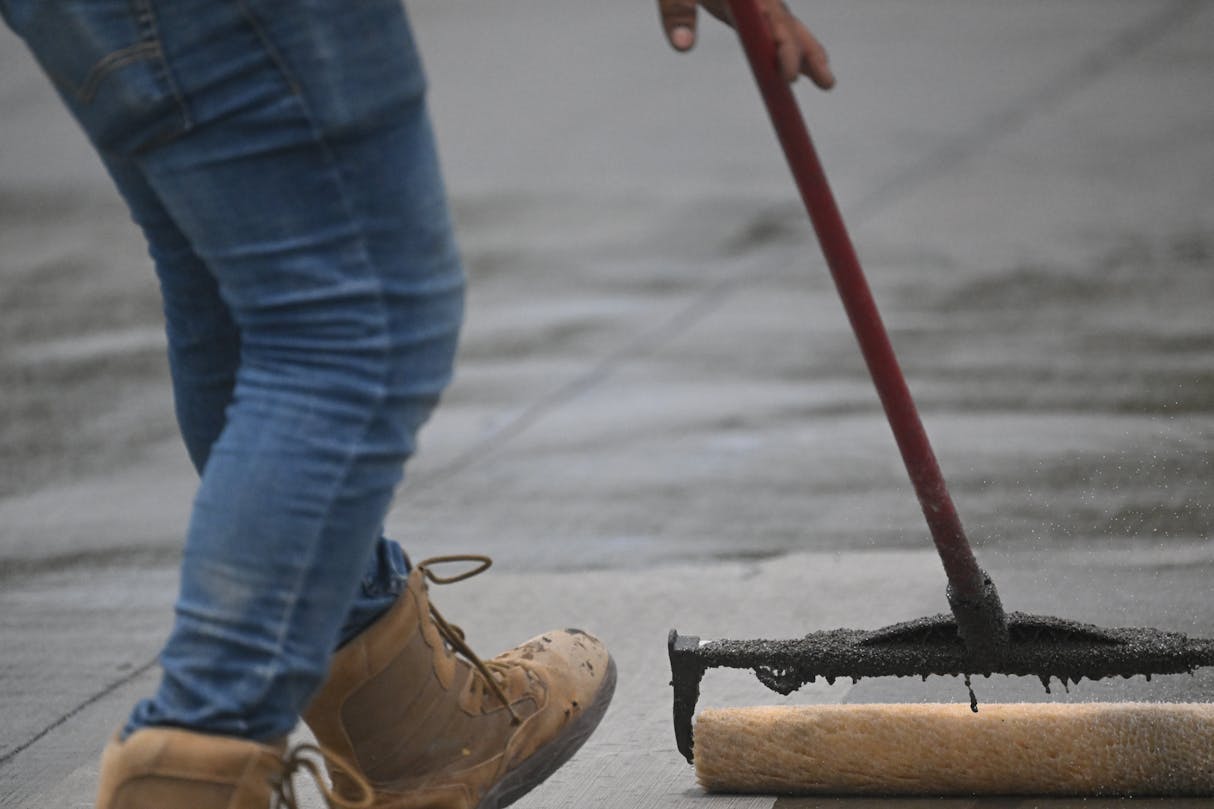
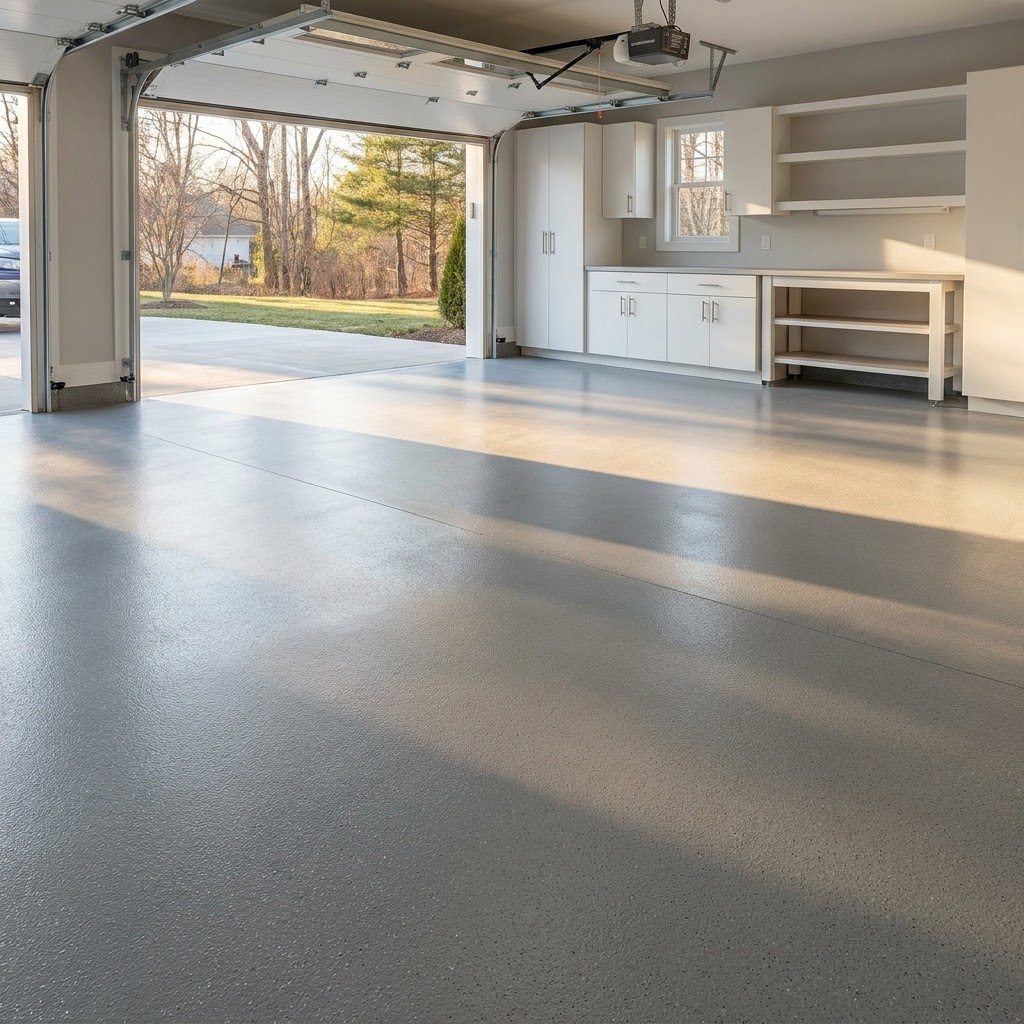
Yes, you can coat a cracked or stained concrete garage floor. But the crack and the stain get treated as two separate problems before any coating touches the slab. Cracks need to be opened, filled with the right material, and ground flush. Stains need to be ground or diamond-cut down to bare, open concrete so nothing blocks adhesion. Skip either step and the coating will eventually show you exactly why it mattered.
Most of the calls we get about peeling floors trace back to one of these two shortcuts. Not the coating brand. Not the color. The prep.
It Starts With Grinding, Not Color Choice
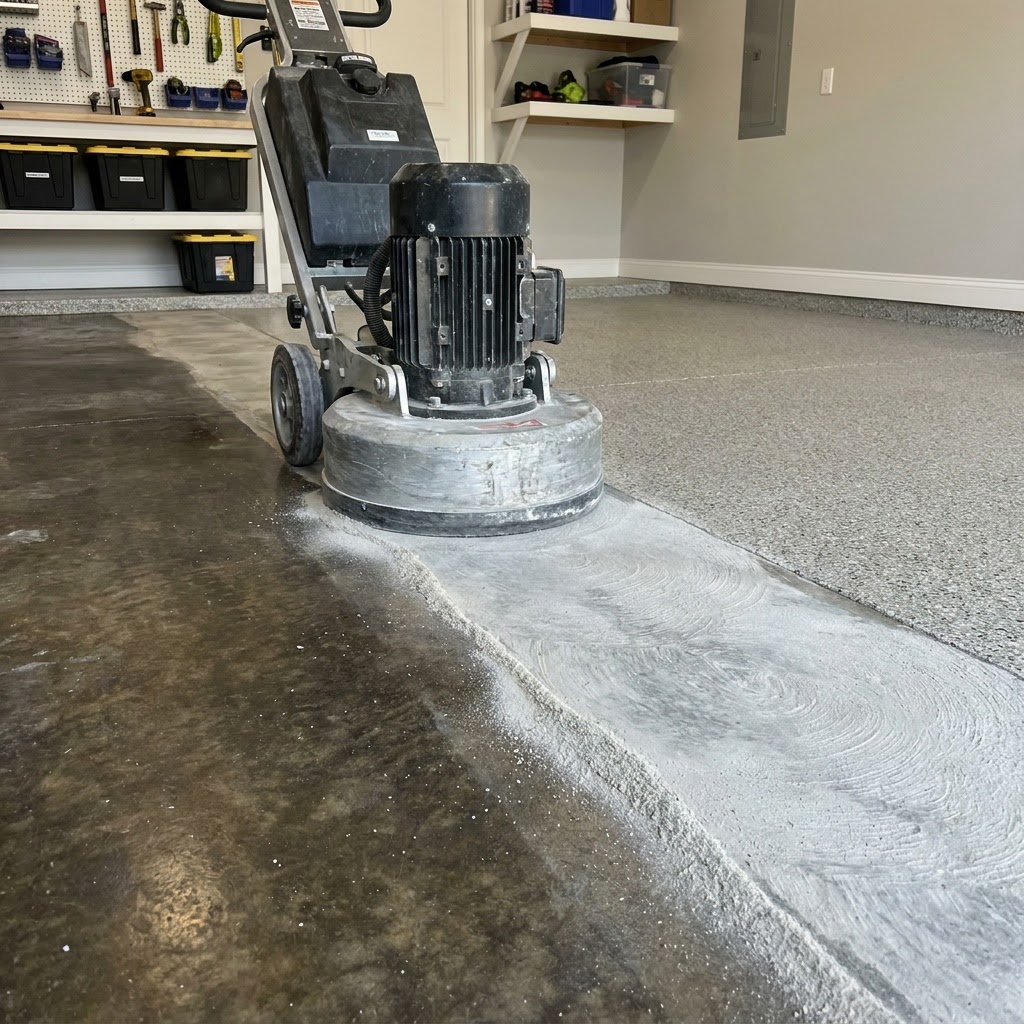
Before we talk about epoxy versus polyaspartic, we talk about the slab itself. Every garage floor we coat gets mechanically ground first, usually with diamond tooling that steps through a grit sequence. A typical pass runs coarse metal-bond diamonds around 30 to 40 grit to strip contamination, then finishes around 80 grit to open the surface pores. That grinding does two things at once. It removes the top layer of concrete, where oil, rust, old paint, and sealers usually live. And it leaves a rough profile, called a concrete surface profile, that coatings can actually grip.
A stained or discolored slab almost always needs more grinding than a clean one. That is not a sales pitch. It is physics. Stains sit in the top few millimeters of the concrete, and until that layer is gone, you are coating over the problem instead of removing it.
What a Crack Actually Needs Before Coating
Not all cracks are equal. A hairline shrinkage crack under about 1/8 inch wide, stable and not moving, is routine. We rout it out slightly, fill it with a semi-rigid polyurea or epoxy crack filler, and grind it flush with the rest of the slab. Once it is filled and leveled, the coating goes over it without drama.
Wider cracks, stepped cracks, or cracks that keep reappearing after a cold winter are a different conversation. Those often point to slab movement, poor base compaction under the concrete, or a joint that was never cut in the right place. Filling that kind of crack without addressing the movement behind it just means the filler cracks again, usually within a season or two.
Around Atlanta’s slab-built homes, we also see seasonal cracking tied to our clay soil. Georgia red clay expands and contracts with moisture more than other soil types, and that movement transfers up into slabs that were poured directly on it. It is one reason an existing crack pattern gets evaluated before we commit to a repair method, not after.
What Stains Actually Do to the Slab
Oil, transmission fluid, and old tire marks penetrate concrete differently depending on how long they sat. A fresh spill might only be surface-deep. A stain that has been there for years, especially under a car that leaked slowly, can soak in several millimeters. Grinding removes that layer. In rare, heavily saturated spots, a chemical degreaser pass ahead of grinding helps pull contamination up before the diamonds go to work.
Rust stains from stored tools or old paint cans behave differently again. They are mineral, not oil, and usually respond well to grinding alone. Old paint or peeling epoxy from a prior failed coating is its own category. That has to come off mechanically, not just scuffed, or the new coating bonds to a weak layer instead of the slab.
Comparing Common Slab Conditions
Here is how the usual conditions we see translate into prep work, before any coating system gets chosen.
| Condition | What’s Happening | What It Takes Before Coating |
|---|---|---|
| Hairline shrinkage cracks | Surface-level, stable, common in most garages | Rout, fill with crack compound, grind flush |
| Wide or stepped cracks | Possible slab movement or base settling | Evaluate cause first, then fill or route around the issue |
| Old oil or fluid stains | Contamination soaked into top layer of concrete | Degrease, then grind until profile is clean |
| Rust spotting | Mineral staining, usually shallow | Standard grinding pass removes most of it |
| Old paint or failed epoxy | Weak bonded layer sitting on the slab | Mechanical removal before any new coating goes down |
| Efflorescence or white haze | Moisture pulling minerals to the surface | Grind and check moisture before coating |
When a Crack Means More Than Cosmetics
Most garage cracks are cosmetic once they are filled and ground. A smaller number point to something structural. Signs worth flagging before you book a coating include a crack that is wider at one end than the other, a crack paired with a door that no longer closes evenly, or one that has visibly widened over a single season. None of that means the floor can’t be coated. It means the crack gets addressed as a structural question first, then as a coating-prep question second.
Picking the Coating Once the Slab Is Ready
Once grinding, crack repair, and stain removal are done, the slab is basically a blank, open surface. That is when coating choice actually matters. A epoxy coating builds a thick base layer and works well for garages that see steady daily use. A polyaspartic coating cures faster, often ready for light foot traffic within 24 hours and vehicle traffic within a few days, which matters in Georgia’s humidity swings where slower-curing systems can struggle. For floors with less damage and a cleaner starting profile, polished concrete or concrete staining can be an option if the client wants a different look than a solid coated finish.
Most coating systems go down in two to three passes, with a base coat, sometimes a broadcast layer, and a topcoat, building to somewhere in the range of 10 to 20 mils of total thickness depending on the system. Temperature and humidity during application matter too. Most coatings want slab and air temperatures between roughly 55 and 85 degrees Fahrenheit, with relative humidity under about 85 percent, which is one reason timing a Georgia install around summer humidity spikes gets discussed on the walkthrough.
What Actually Drives the Cost
Cracked and stained floors almost always cost more to prep than a clean slab, because there is more grinding, more fill material, and sometimes more time between steps for fillers to cure before grinding them flush. Square footage matters. The coating system matters. But the biggest variable on a damaged floor is simply how much grinding and repair the slab needs before a coating can go on at all. That is not something we can estimate from a description over the phone. It needs eyes on the floor. The only honest way to get a real number is a walkthrough and a free, itemized estimate.
The Short Version
A cracked or stained garage floor is not a reason to skip coating it. It is a reason to be clear-eyed about what has to happen first. Grinding removes the problem instead of hiding it. Crack repair addresses the cause, not just the gap. Once that work is done, the floor is just concrete again, ready for whatever finish fits the way the garage actually gets used.
If you are looking at a cracked slab, old stains, or a floor from a previous coating that is already failing, the next step is simple. Reach out through the contact page for a free estimate, and we’ll walk the floor before anyone talks finish or color.