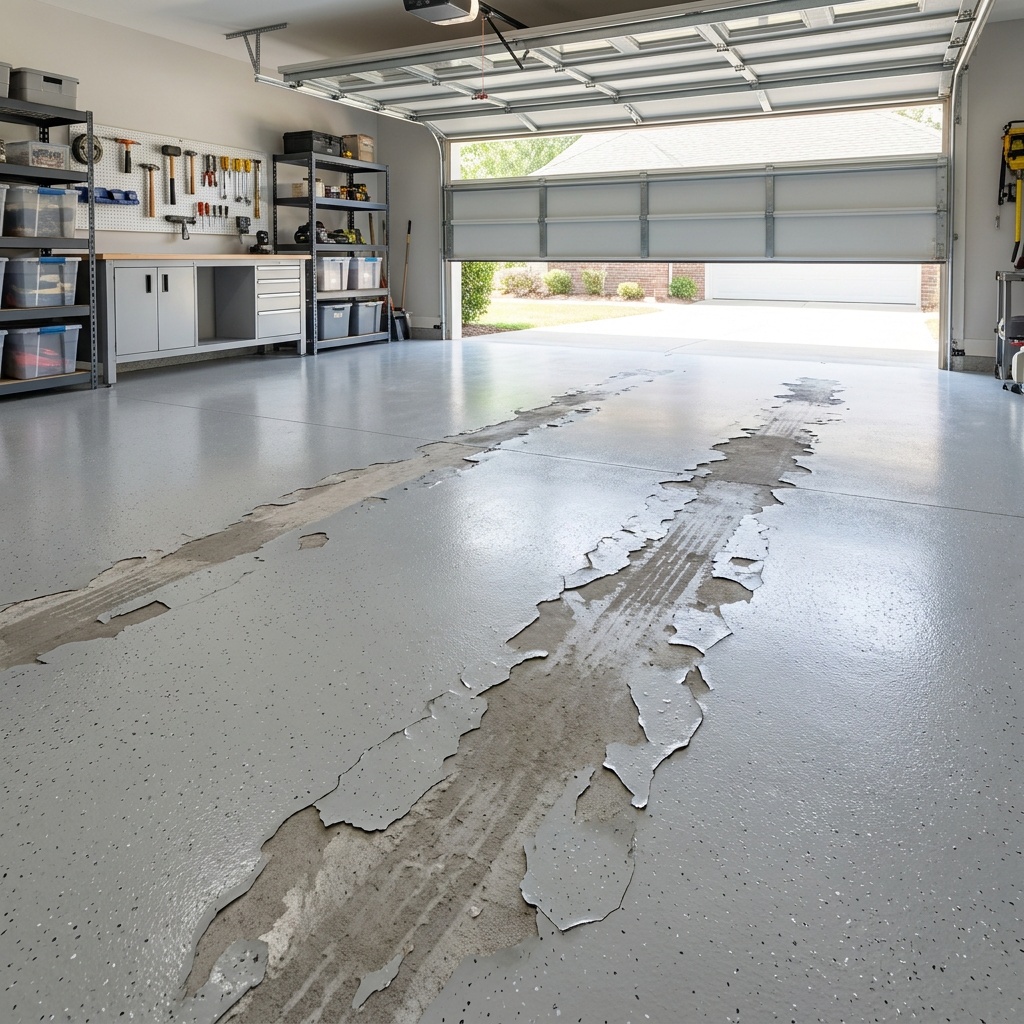
A garage floor coating installed wrong almost always traces back to one thing: the concrete wasn’t ground or profiled before the coating went down. You’ll see it as peeling at tire tracks, bubbling across large sections, or a surface that never fully hardens underfoot. Hot tires can lift a bad bond within the first summer. If any of that sounds familiar, the fix starts with diagnosing the install, not just patching the surface.
Why Prep Is the First Place We Look
Every failed coating call starts with the same question. Was the slab ground before coating went down?
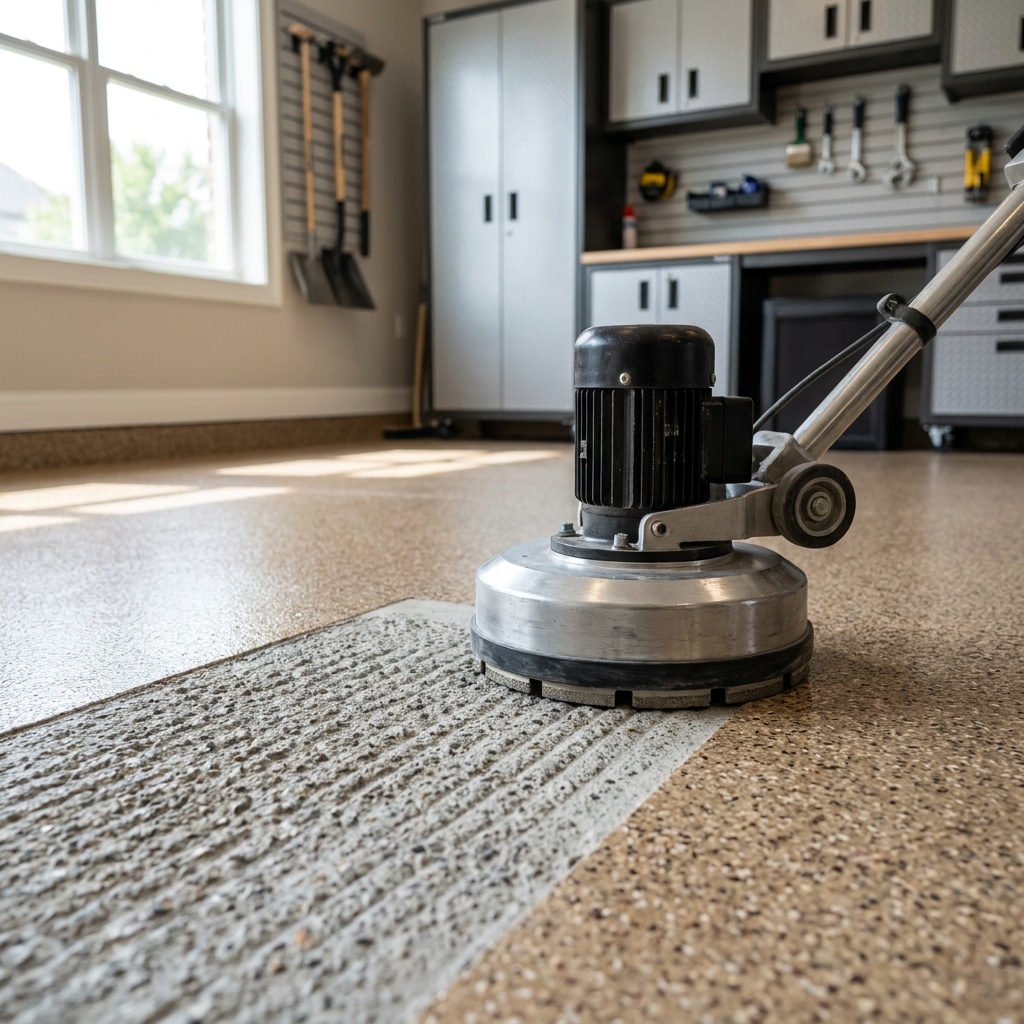
Concrete cures with a dense, often sealed surface called laitance. Epoxy and polyaspartic systems need a mechanically opened surface to bond into, typically a concrete surface profile (CSP) of 2 to 3, created by diamond grinding with 30- to 80-grit metal-bond tooling. Acid etching alone almost never gets there. On slab-built homes around Alpharetta, Milton, and Woodstock, we regularly find builder-grade concrete that was never finished with coating adhesion in mind. It looks smooth. It isn’t ready.
Skip the grinding step, and the coating sits on top of dust and curing compounds instead of locking into open pores. It can look flawless on install day. Then a hot summer, a few parked tires, or one dropped wrench break the surface tension. The whole system lets go, sometimes in sheets a foot wide.
Signs the Install Went Wrong
Some problems show up in the first week. Others wait for the first humid Georgia summer. Here’s what actually shows up on our repair calls:
- Peeling that starts at tire paths. This is the classic sign of no grinding and no real mechanical profile. The coating was likely rolled over an etched or sealed slab instead of a ground one.
- Bubbles or fisheyes spread across large areas. Usually moisture vapor trapped under a coating applied to damp concrete. Garage slabs without a vapor barrier are especially prone to this, particularly in spring.
- Soft, tacky spots that never fully cure. Often a mixing ratio error or coating applied outside the 55-85°F range most epoxy and polyaspartic systems require to set properly.
- Coating flakes off in large sheets rather than small chips. Chips mean wear. Sheets mean the bond never happened at all.
- A hazy, waxy film across the surface. Known as amine blush, this forms when epoxy cures in high humidity without a blush-resistant hardener, and it blocks the next coat from bonding.
- Visible ridges or trowel lines under the clear coat. A sign of uneven mil thickness, often from a single thin pass instead of the 8 to 12 mils a proper system needs.
- Color flecks bunching or sliding underfoot. This happens when a top coat gets applied before the broadcast flake layer has set, sometimes inside the same work day.
Aesthetic Flaws vs. Structural Failure
Not every imperfection means the whole floor has to come out. A few trapped bubbles near a floor drain might be cosmetic. Peeling that spreads under your car every month is structural. The test is simple: does the problem grow? A coating that was installed wrong rarely stays the same size. It spreads from the first failure point outward, usually along the path of heaviest traffic.
If you’re seeing active spread, patching over it just delays the real decision. The existing coating typically has to be ground off completely, which adds time and cost on top of whatever system goes down next, whether that’s a fresh epoxy coating or a faster-curing polyaspartic coating.
What Drives the Cost of Fixing It
Correcting a bad install almost always costs more than doing it right the first time. The reason is prep. A floor with failed coating needs that coating ground off before a new surface profile can even be cut, which is extra passes compared to a bare slab. Square footage, how much of the old coating has delaminated, and whether the concrete underneath has pitting or cracks all factor in. Some garages need two grinding passes. Others need crack fill and spot leveling before anything new goes down. The only honest way to price that is to look at the floor, so request a free, itemized estimate through our contact page rather than guess from a phone description.
What a Correct Install Looks Like Instead
A properly prepped garage floor goes through grinding, crack and joint repair, then a moisture check before anything gets rolled on. Relative humidity in the slab generally needs to read below manufacturer thresholds, and ambient conditions should sit in a workable range before coating starts. Coats go down with controlled recoat windows, often 12 to 24 hours apart depending on the system. Polyaspartic systems move faster and can sometimes handle light foot traffic the same day, which is one reason we point homeowners toward that option when timeline matters. You can see the difference in approach on our homepage, or compare finish options including polished concrete for garages that want a harder, coating-free surface entirely.
If You Already See These Signs
Stop parking on the affected area if the peeling is active. Take photos now, including close-ups at the edge of any lifted coating. That edge tells us whether the failure is adhesion-related or moisture-related, which changes the repair plan. Then get a second opinion before paying for another topical fix. A coating that was installed wrong once usually fails the same way twice, unless the prep step actually changes.
Frequently asked questions
How soon does a bad garage floor coating usually start failing?
Many adhesion failures show up within the first 3 to 6 months, often after the first stretch of hot weather or heavy tire traffic.
Can a peeling coating be patched instead of fully redone?
Small, isolated spots sometimes can be. Spreading peeling usually means the whole coating needs to come off before a new one goes down.
Is bubbling always a moisture problem?
Not always, but it’s the most common cause. Trapped air from a rushed roll-out is the other main cause, and both require grinding to fix correctly.
Does acid etching work instead of grinding?
Etching alone rarely creates enough surface profile for coatings to bond long term, especially on dense, troweled builder-grade concrete common in this area.
How do I know if my existing floor was ground before coating?
Look at the edges of any chips or peeling. A ground floor shows a rough, slightly porous gray surface underneath. An unground floor often shows a smooth, shiny layer instead.
What coating option holds up best against future install errors?
No coating prevents errors on its own. Polyaspartic systems cure faster and are less weather-sensitive during install, which reduces one common source of failure.
If your garage floor shows any of these signs, don’t guess at the cause. Reach out through our contact page for a free, itemized estimate and a straight answer on whether it’s a patch or a full redo.