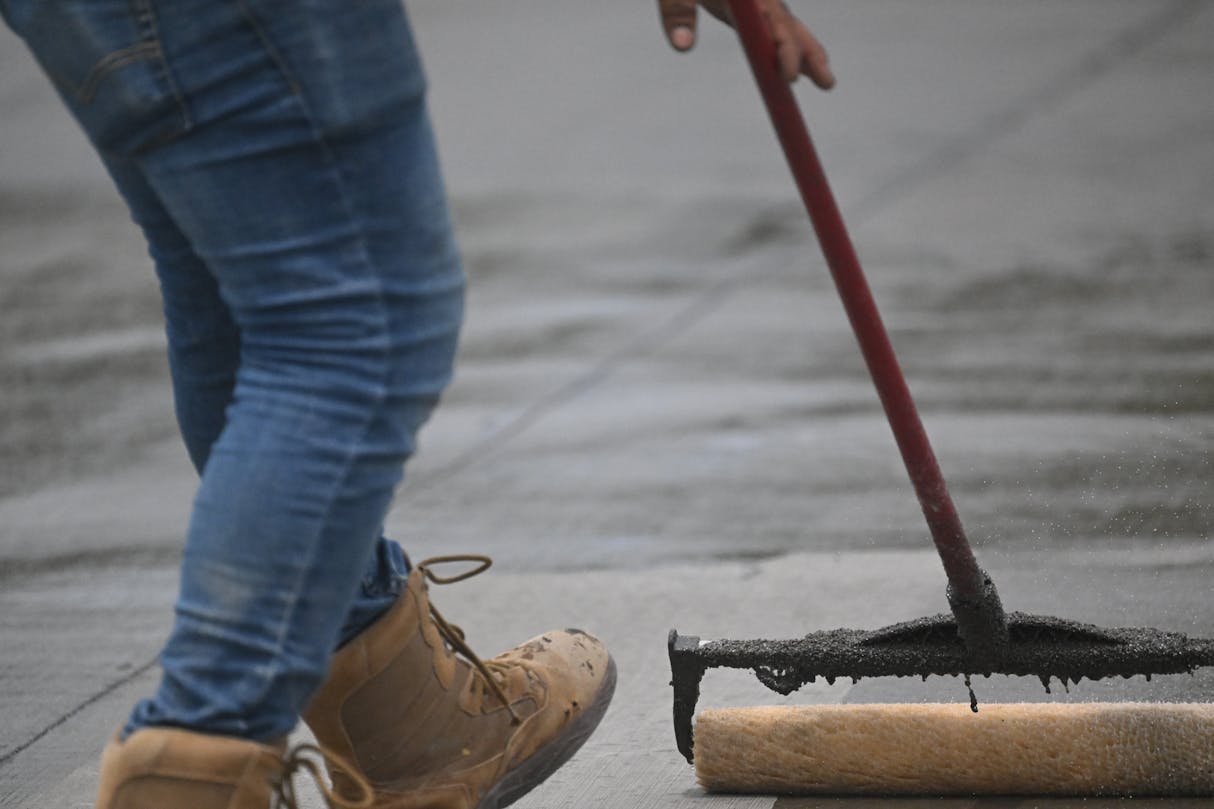
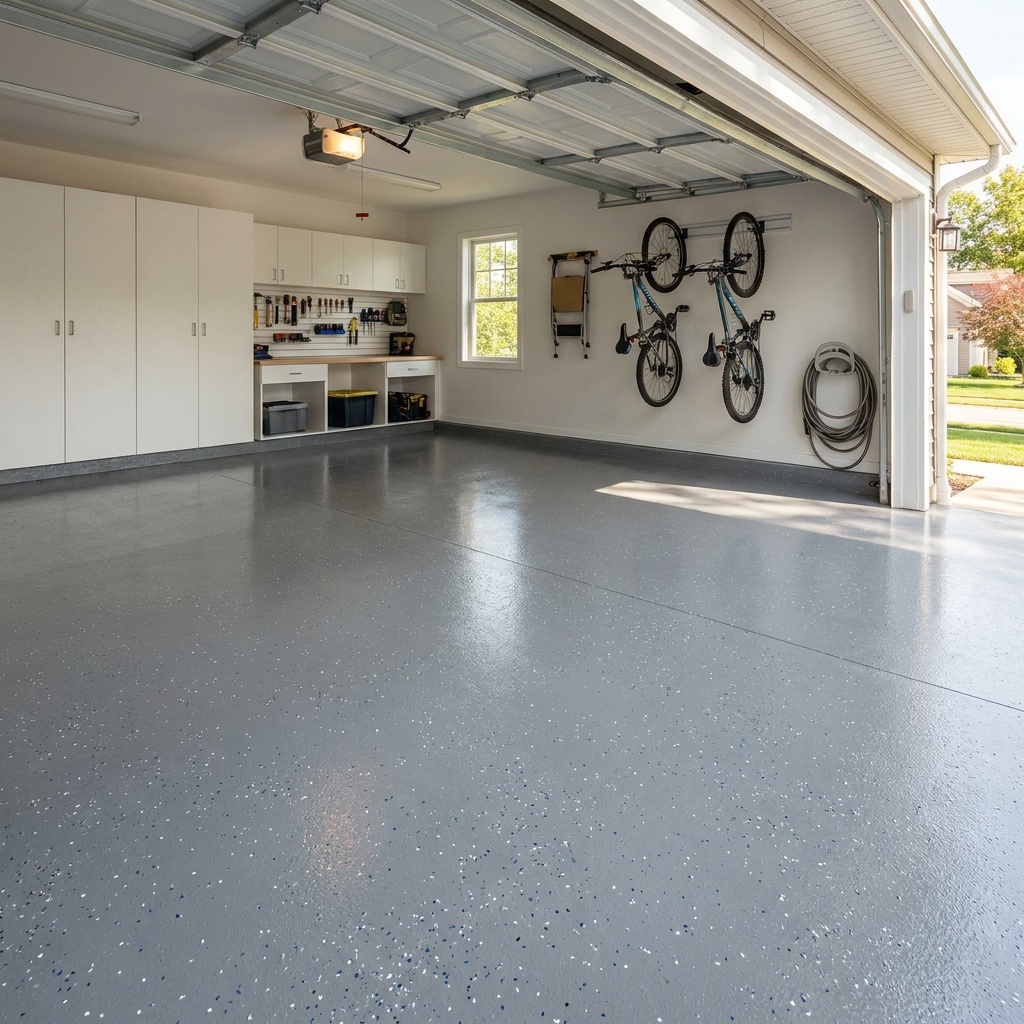
Polyaspartic coatings generally handle Georgia’s humidity better than the alternatives, mainly because they cure fast enough to avoid trapping moisture vapor mid-reaction. Epoxy still performs well here, but only when the slab is ground correctly and the install respects the humidity window. The coating matters less than what happens before it goes down. Skip the grinding, and no coating system survives an Atlanta summer for long.
Grinding comes before any humidity talk
Nearly every coating failure we get called out to inspect traces back to one thing. Something got skipped during prep. Usually it’s grinding.
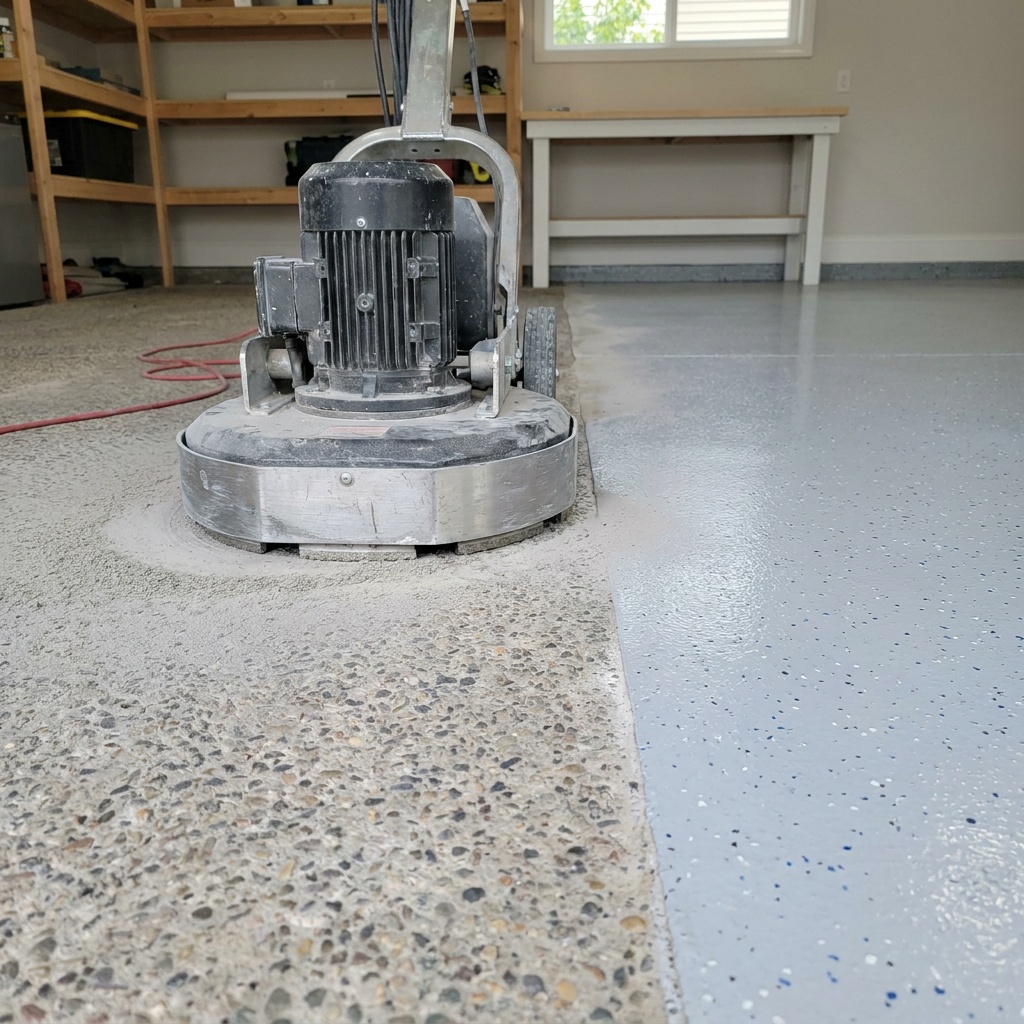
Concrete has a dense, sealed surface layer called laitance. Old paint, sealer, mastic, and curing compounds sit on top of it. None of that gives a new coating anything to grip. A coating bonds to concrete mechanically, through surface profile, not just chemistry. That’s why grinding happens first, every time, no exceptions.
We run diamond grinders across the slab in a set sequence, typically starting around 30-40 grit metal-bond and stepping up from there depending on the slab’s condition. This opens the surface and brings it to roughly a CSP 2 to CSP 3 profile, the range most coating manufacturers specify for a mechanical bond. Cracks get routed and filled. Low spots get built back up with a compatible patching compound. Any oil staining gets treated before it can bleed through a fresh coat.
Humidity plays into this stage too, not just the final coating step. Grinding dust and any residual moisture in the slab need to be gone before coating begins. That’s why relative humidity and slab surface temperature both get checked before any resin gets mixed.
Why Georgia humidity is the real variable
Metro Atlanta runs at 60-90% relative humidity for a good stretch of the year, especially from June through September. Slab temperatures swing hard too, from around 55°F on a January morning to 95°F on a July afternoon. That’s a substrate that’s constantly moving, not a stable surface.
Two specific problems show up when coatings meet high humidity without planning around it.
First, moisture vapor transmission. Slabs sit on grade or on soil, and Georgia’s red clay holds water well. That moisture pushes upward through the concrete. If a coating goes down before that moisture equalizes, or without a vapor-tolerant system, it can drive blisters and delamination months later, sometimes not until the following summer.
Second, amine blush. Epoxy resins react with moisture and carbon dioxide in humid air while curing, leaving a waxy film on the surface. Left alone, that film weakens adhesion for any topcoat and leaves a hazy, sometimes slick finish underfoot.
Neither problem is a reason to avoid coating a Georgia garage. Both are reasons to pick a system and a schedule built around the climate instead of against it.
How the coating systems compare in humid conditions
We get asked to compare epoxy, polyaspartic, polished concrete, and stain almost every week. Here’s how each actually behaves once summer humidity shows up.
| System | Typical cure time | Humidity tolerance | Notes for Georgia slabs |
|---|---|---|---|
| Epoxy | 24-72 hours to walk on, 5-7 days to full cure | Moderate; needs controlled RH during application | Best in shoulder-season weather or a conditioned garage |
| Polyaspartic | 1-4 hours to walk on, 24-48 hours to full cure | High; cures across a wider temperature and humidity range | Handles summer installs with lower blush risk |
| Polished concrete | No cure time; densifier reacts within the slab | Not affected by ambient humidity | Success depends on slab quality, not weather |
| Concrete staining | 4-24 hours dry time before sealing | Moderate; sealer choice matters more than the stain | Pair with a moisture-tolerant sealer for best results |
The pattern is simple. Faster cure means less time for humidity to interfere mid-reaction. That’s the core reason polyaspartic coating has become the default recommendation for garages here, especially ones without insulated doors or climate control.
Where epoxy still makes sense
Epoxy isn’t obsolete. It builds thicker films, self-levels better over minor imperfections, and gives more flexibility on color and flake broadcast. For a garage coated in spring or fall, with daytime humidity under roughly 85% and slab temperatures in a reasonable range, epoxy coating performs well and holds up for years.
The tradeoff is timing. Epoxy needs a longer open cure window, and that window lands right when Georgia humidity likes to spike. We schedule around it. That’s the job. A homeowner doesn’t need to track dew points and vapor drive personally. The crew handles that part before the first coat ever goes down.
What we check on installation day
A handful of numbers drive the go or no-go call before mixing starts.
- Slab surface temperature should sit at least 5°F above the dew point, or condensation can form as the coating skins over.
- Relative humidity above roughly 85% at application time usually pushes us to reschedule or switch systems to polyaspartic.
- Slab moisture, tested with an RH probe or calcium chloride kit, should read within the coating manufacturer’s stated threshold.
- Ambient and slab temperatures generally need to fall between 50°F and 90°F, depending on the product.
None of this is guesswork. It’s measured, every time, before a drop of resin gets mixed.
Polished concrete and staining as humidity-proof alternatives
Not every garage needs a film-forming coating. Polished concrete mechanically densifies and refines the slab itself instead of layering resin on top, so ambient humidity during the process barely matters. It’s a strong option for garages doubling as workshops or extended living space, where a harder, more permanent floor matters more than color options.
Concrete staining sits in between. The stain reacts chemically with the slab, then a sealer goes on top. The sealer is where humidity tolerance actually lives. Stain color gets the attention, but sealer selection is what decides whether the floor holds up through a Georgia August.
Seasonal timing around Atlanta
We see the heaviest install requests in two windows: April through May, and September through October. Both sit outside the worst humidity stretch. That’s not an accident. Homeowners across Alpharetta, Woodstock, and Cumming have learned that a spring or fall install sidesteps the muggiest months entirely.
Summer installs still happen, and they still hold up. They just call for polyaspartic more often than epoxy, along with tighter scheduling around morning humidity spikes. Winter installs are less common but workable, provided slab and ambient temperatures stay in range and the garage doesn’t drop below freezing overnight during cure.
What actually drives cost on a humid-climate job
Pricing depends on how much grinding and repair the slab needs, total square footage, the coating system selected, and any existing damage like spalling, cracks, or oil saturation. A slab that’s already shed one failed coating usually needs more aggressive grinding to remove old material before anything new goes down. None of that gets estimated accurately over the phone. A walk-through and a free, itemized estimate through Atlanta Concrete Floors is the only reliable way to get real numbers for a specific garage.
The short version
Polyaspartic handles Georgia humidity with the widest margin for error. Epoxy still performs well with the right timing and prep. Polished concrete sidesteps the humidity question almost entirely, and staining depends heavily on the sealer paired with it.
But the coating choice only matters after the slab is ground correctly, tested for moisture, and brought to the right surface profile. That part doesn’t change with the season. It’s not something to shortcut, regardless of which system ends up on the floor. Visit the Atlanta Concrete Floors homepage to see the full range of coating systems available for Georgia garages.
Curious what your own slab needs before committing to a coating. Request a free, itemized estimate and get a straight answer based on an actual look at the concrete.