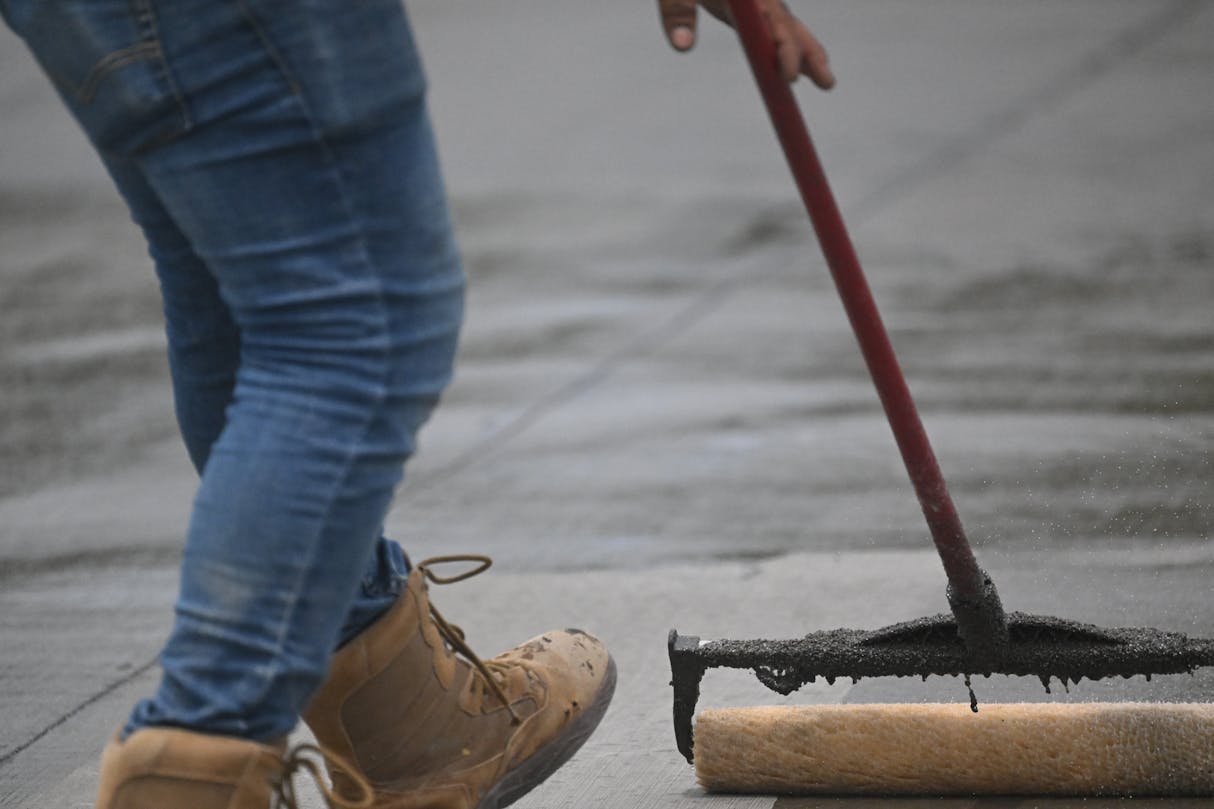
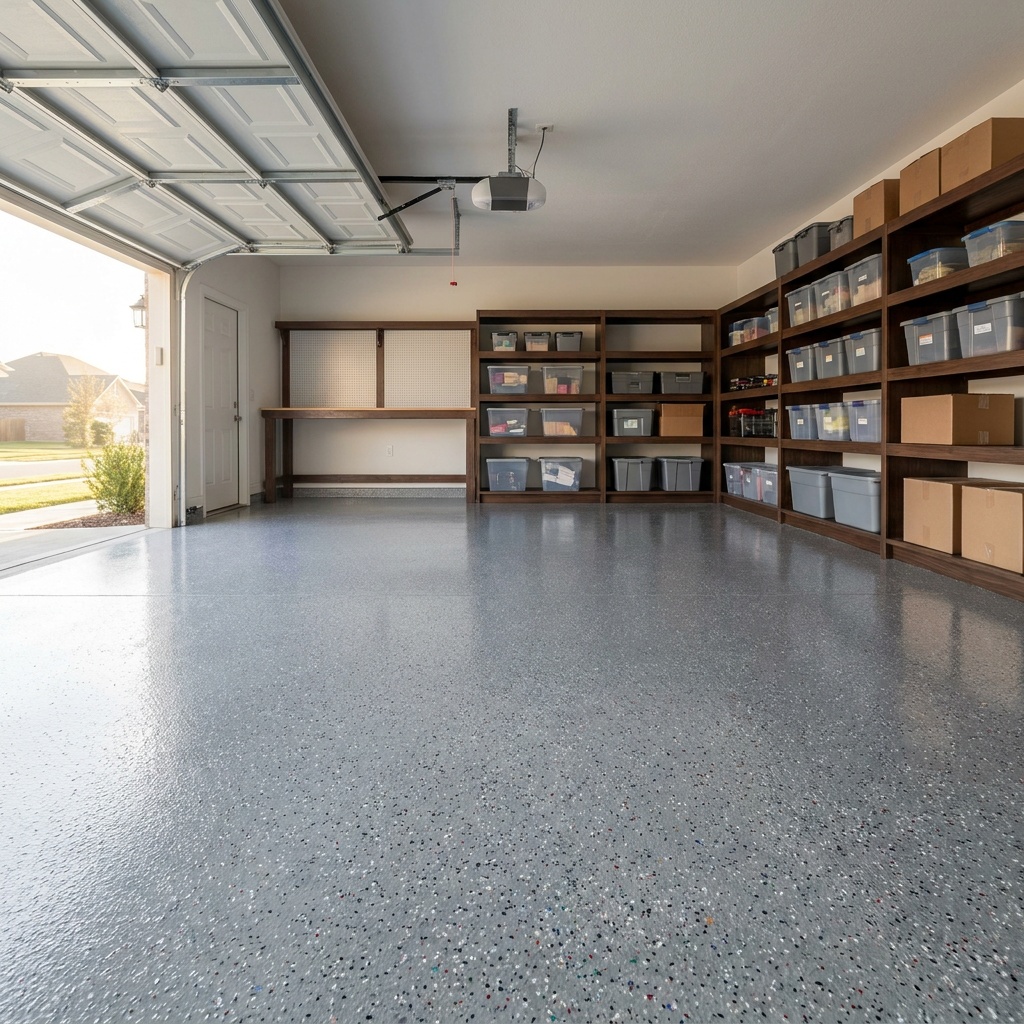
Epoxy garage floor coatings typically become safe to walk on within 12 to 24 hours and ready for light vehicle traffic in 3 to 5 days. Full chemical cure, the point where the coating reaches its maximum hardness and chemical resistance, takes about 5 to 7 days for most epoxy systems. Polyaspartic topcoats move faster, often handling vehicles within 24 to 48 hours. None of that timeline means much if the concrete underneath was not prepared correctly first.
Every job we run starts with diamond grinding, not an acid etch and a prayer. Grinding opens the concrete’s pore structure so the coating can lock into the surface instead of sitting on top of it. Skip that step and no amount of curing time will stop the coating from lifting later. Cure time is a chemistry question. Adhesion is a mechanical one, and it gets settled before the first coat ever touches the slab.
Cure time vs. dry time: they are not the same thing
Homeowners often use these words interchangeably. They describe different stages.
Dry time, sometimes called tack-free time, is how long it takes the surface to stop feeling sticky. That happens in 4 to 8 hours for most epoxy formulas under normal Georgia conditions. You can walk on the floor in socks around this point, but the coating is still soft underneath.
The recoat window comes next, usually 12 to 24 hours after the previous coat. Wait too long past that window and the next layer may not chemically bond as well, requiring a light scuff-sand first. Cure time is the final stage. It refers to the coating reaching its full hardness, chemical resistance, and abrasion resistance, which is when it can actually handle a hot tire rolling off the highway.
A realistic cure timeline, coat by coat
Different coating systems cure at different speeds. This matters when you are deciding between a straight epoxy system, a polyaspartic topcoat, or a polished concrete finish for the same garage.
| Coating system | Safe to walk on | Light vehicle traffic | Full cure |
|---|---|---|---|
| Water-based epoxy | 18–24 hours | 5–7 days | 7 days |
| 100% solids epoxy | 12–24 hours | 3–5 days | 5–7 days |
| Polyaspartic topcoat | 4–6 hours | 24–48 hours | 2–3 days |
| Polished concrete densifier | Same day | Same day | N/A (mechanical, not chemical) |
The polyaspartic coating option is the one we recommend most often when a homeowner needs the garage back in service fast, since it skips much of the multi-day waiting that straight epoxy requires. A full epoxy coating system still makes sense for garages that will see heavy chemical exposure or long-term shop use, since the base layer builds a thicker, more chemically resistant film.
What actually slows cure time down
Cure time is not fixed. Several conditions push it longer or shorter.
- Temperature: Most epoxies cure properly between 55°F and 90°F. Below 55°F, curing slows dramatically. Below 50°F, some formulas may not cure at all.
- Humidity: Relative humidity above 85% can trap moisture at the surface and cause a hazy film called amine blush.
- Slab moisture: A slab still releasing vapor from below will extend cure and can cause bubbling regardless of air temperature.
- Coating thickness: A single coat applied too heavy traps solvents underneath and cures unevenly. Most systems are built from two coats at a controlled mil thickness rather than one thick pour.
- Number of coats: A base coat plus a topcoat, sometimes a third for flake broadcast systems, each adds its own dry and recoat window to the total project timeline.
Why the grinding step adds a day now but saves years later
We grind every slab with a diamond tooling sequence, typically starting around 30-grit metal bond and stepping up through finer transitional grits to reach a surface profile the coating can grip. This step alone can take a full day on a two-car garage, longer if there is old paint, mastic, or oil staining to remove first. It feels like it slows the project down. It actually prevents the single most common coating failure we get called out for: peeling that traces straight back to a slab that was never properly opened up.
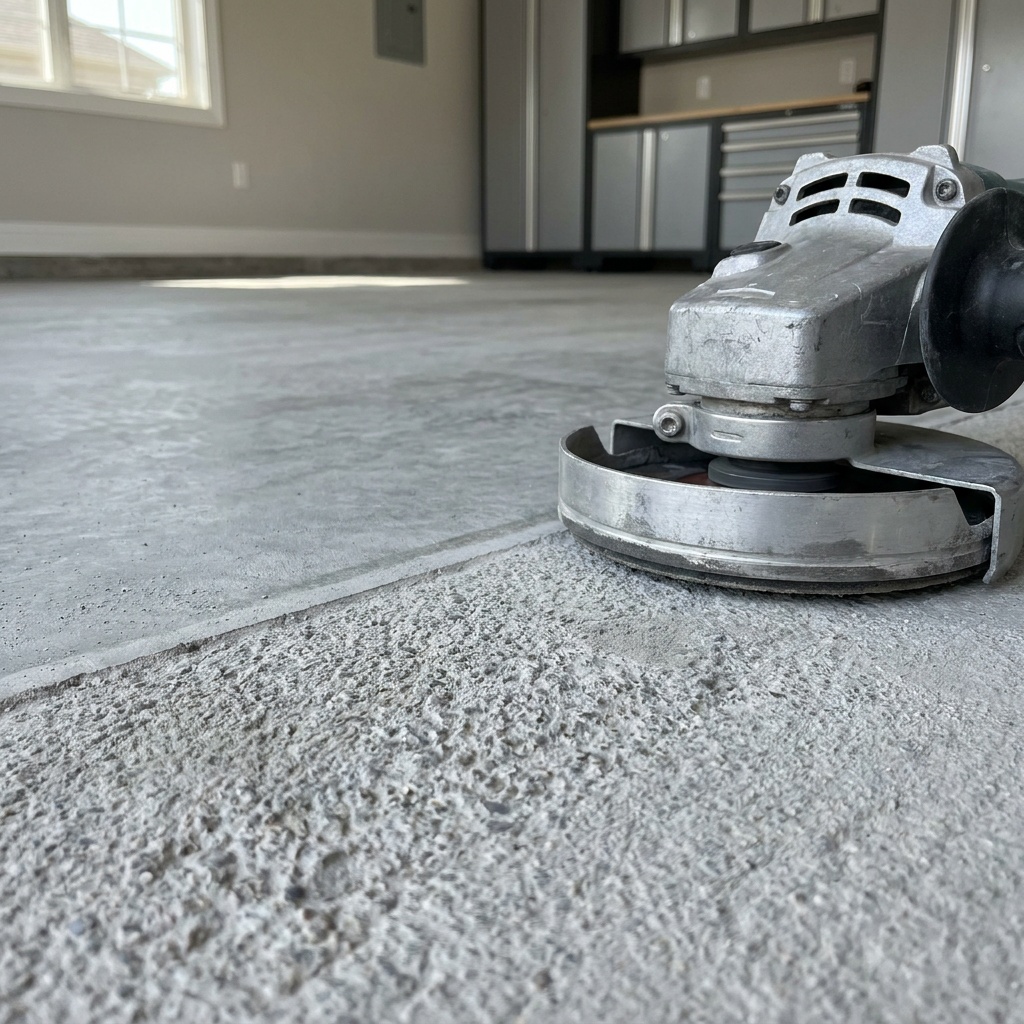
Once the profile is right, cure time behaves predictably. Skip the grinding and even a coating that cured perfectly on paper can lift within months, because the bond was never mechanical in the first place. This is also where polished concrete diverges from coatings entirely. A polished concrete finish is mechanically ground and densified rather than cured like a film coating, which is why it has no real cure window at all.
Day-by-day: what a typical coating project looks like
Most residential two-car garages run on a schedule close to this:
- Day 1: Diamond grinding, crack and joint repair, moisture check.
- Day 2: Base coat application, allowed to reach tack-free before foot traffic.
- Day 3: Flake broadcast if included, scraped back once the base coat sets.
- Day 4: Topcoat application, typically polyaspartic or a urethane sealer.
- Days 5–7: Full cure. Vehicles wait until this stage, not before.
Larger garages, three-car layouts, or slabs with existing damage from spalling or old adhesive can add a day or two to the front end for repair work. That is a prep-time question, not a cure-time question, and it is worth separating the two when you are planning around the project.
What happens when cure time gets rushed
We see the same handful of issues when a homeowner or a rushed crew moves a car back in too early.
- Hot tire pickup, where tires soften and lift the still-curing coating in small patches.
- Permanent tread marks pressed into a coating that had not reached full hardness.
- Scuffing from moving boxes or equipment before the surface cured enough to resist abrasion.
- Amine blush, a waxy film that forms when humidity was too high during cure and blocks proper topcoat adhesion.
None of these are cosmetic-only problems. Each one shortens the life of the coating and often means a partial regrind and recoat rather than a quick touch-up.
How Atlanta-area weather affects the schedule
Cure time is not identical in every season around here. Summer humidity across Alpharetta, Johns Creek, and Suwanee regularly pushes past the 85% threshold on muggy mornings, which is why we schedule coating work for lower-humidity windows when possible. Winter brings the opposite problem in Woodstock and Marietta garages that sit unheated. A slab sitting at 45°F overnight needs to warm before coating goes down at all, and cure stretches out even after that. Cumming and Milton jobs with attached, semi-conditioned garages tend to see the most predictable timelines because temperature swings less.
Getting an accurate timeline for your garage
Square footage, the amount of grinding required, existing slab damage, and which coating system you choose all shift the schedule and the scope of work. A garage with minor wear and no cracks moves through prep quickly. A garage with old peeling paint, oil staining, or low spots needs more grinding time and sometimes leveling compound before any coating goes down. If color and pattern matter to you as much as durability, a concrete staining option can be layered into certain systems, which adds its own dry time before sealing. The only way to get a real schedule, not a generic estimate, is to have the slab looked at directly. Request a free, itemized estimate and we will walk the garage, check moisture and condition, and lay out both the prep timeline and the cure timeline before any work starts.
Frequently asked questions
Can I park in the garage 24 hours after coating?
For most 100% solids epoxy and polyaspartic systems, yes, light vehicle traffic is generally fine at 24 to 48 hours. Full cure still takes several more days, so avoid hard braking, sharp turns, or leaving a hot tire parked in one spot during the first week.
Does polyaspartic really cure faster than epoxy?
Yes. Polyaspartic chemistry cures faster than standard epoxy in most temperature ranges, often reaching a walkable state in 4 to 6 hours and vehicle-ready in 1 to 2 days, compared to several days for straight epoxy.
How long should I wait before parking a car with hot tires?
Wait for full cure, roughly 5 to 7 days for epoxy or 2 to 3 days for polyaspartic, before parking a car straight off the highway. Hot tire pickup on an undercured coating is one of the most common early-failure calls we get.
Does Georgia humidity affect how long epoxy takes to cure?
It can. Relative humidity above 85% slows curing and raises the risk of amine blush, a hazy surface film that interferes with topcoat adhesion. We track conditions during application and time work around lower-humidity windows when possible.
If you want a real timeline instead of a guess, reach out through our contact page for a free, itemized estimate built around your slab’s actual condition.